
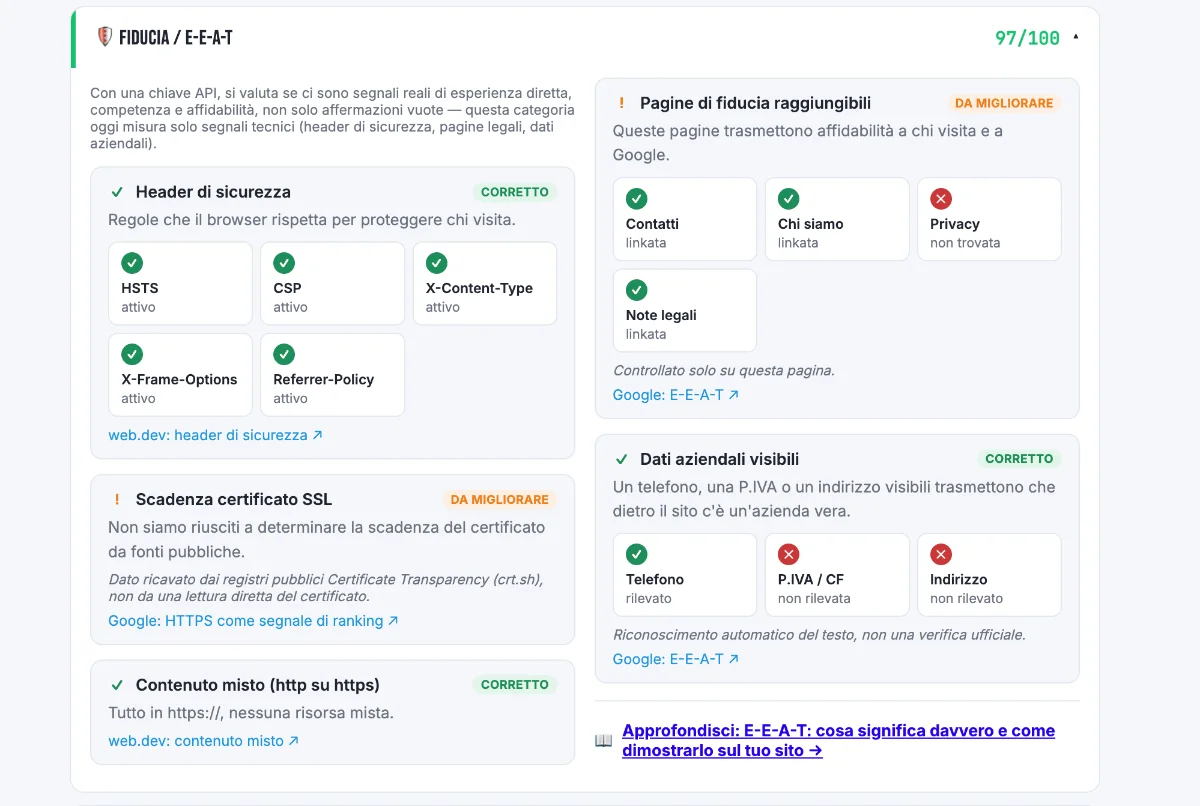
E-E-A-T is the model Google uses to judge whether content is credible: experience, expertise, authoritativeness and trust. It isn’t a score you can read anywhere, and it isn’t a direct ranking factor: it’s a set of signals that Google’s systems try to recognize and that quality raters use to assess results.
It’s worth knowing because it describes what sets a page written by someone who knows the subject apart from one that repeats what can be found elsewhere.
The four signals
- Experience Have you lived what you’re writing about? A review from someone who used the product, your own photos and screenshots, details only someone who was there would know: these are the most concrete signals to show.
- Expertise Do you really know how it works? It shows in precision: explaining a complicated thing clearly, without detours, counts for more than technical jargon.
- Authoritativeness Do others recognize you as a source? It depends on links and mentions from other sites and on a reputation built over time in your field. It doesn’t happen overnight.
- Trust Can people rely on the site? It covers the whole site: HTTPS enabled, real contact details, clarity about who is behind it, and no deceptive practices.
Google names trust as the most important of the four: the others help build it.
Where scrutiny is highest
For topics that can affect people’s health, money or safety, known as YMYL (“Your Money or Your Life”), Google applies higher standards. An article about a medication or an investment has to show expertise and sources far more than one about a recipe.
How to show it on your site
- A recognizable author Sign every article with a real name and a short bio explaining why you’re the right person to write about it.
- An About page A concrete one, with the story of the business and real details, not generic text.
- Visible contact details An address, email or phone number that’s easy to find, and a working contact page.
- Cited sources When you report data or statistics, say where they come from and link to the original source.
- Up-to-date content Review your oldest articles instead of leaving them untouched for years.
You can reinforce these signals with structured data: the Person and Organization types state explicitly who writes and who publishes. But content makes the difference: writing it well matters more than any technical tweak.
FAQ
Is E-E-A-T a direct ranking factor?
No: there is no measurable “E-E-A-T score”. It’s a quality model, and Google’s systems try to reward content that shows its signals.
Google describes it in the guidelines for quality raters, people who assess results to help improve the algorithms. Their ratings don’t directly change a site’s position.
Can a small site compete with a big one?
Yes: on a specific topic, first-hand experience is often easier to show for a small, specialized site than for a general portal.
Focus on what big sites don’t have: real cases, your own photos and data, answers to niche questions. Authoritativeness grows over time, but experience and expertise can be shown in your very first article.
Do I need to show the author’s real name?
It isn’t required, but it helps, especially on topics where the writer’s expertise changes the value for readers.
An author with a name, photo and short bio makes it possible to verify who is behind the content. On YMYL topics this matters even more.
How do I show first-hand experience?
With material only someone who has lived the situation can have: your own photos and screenshots, measured results, mistakes you made and how you fixed them.
Avoid generic images and text that summarizes other sources. Even a small, specific detail, such as a choice you made and why, conveys more experience than a general statement.
Can I measure my site’s E-E-A-T?
Not directly, because there is no score. You can, however, check the signals it’s made of: who the author is, whether contact details are visible, whether the site is secure.
The Trust category of our free audit checks the technical signals: security headers, certificate expiry, legal pages and visible company details. With an Anthropic API key it also evaluates how deep the first-hand experience signals in the text are.
This article is for informational purposes. SEO results depend on many factors and timelines vary by site.