
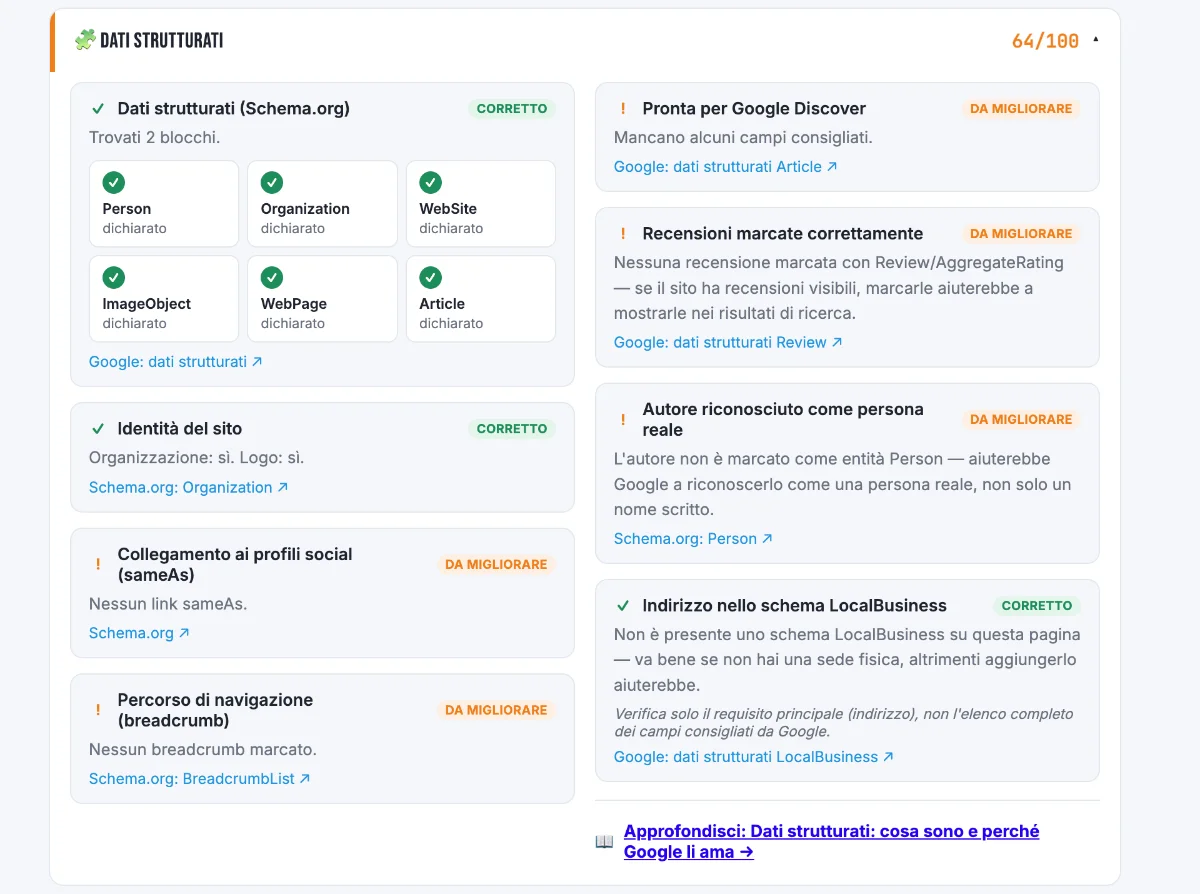
Structured data is a set of labels added to a page’s code that tell search engines what each piece of information means: this is a price, this is the author, this is a rating. Without labels, Google has to infer it from the text, and sometimes it gets it wrong.
How it works
Schema.org is a shared vocabulary, created by Google, Microsoft, Yahoo and Yandex, that gives standard names to content types and their properties. The format Google recommends is JSON-LD: a block of code that visitors never see, placed in the page alongside the normal content.
Here is a minimal example for a business, to be placed inside a <script type="application/ld+json"> tag:
{
  "@context": "https://schema.org",
  "@type": "Organization",
  "name": "Company name",
  "url": "https://yoursite.com",
  "logo": "https://yoursite.com/logo.png"
}
Why it’s worth doing
The most visible benefit is rich results: listings with star ratings, prices or cooking times, which take up more space than a plain result. Google doesn’t always show them, even when the data is correct, but without structured data it can’t show them at all.
There’s also a less obvious benefit: structured data helps search engines, and other systems that read it, understand the context of the page with certainty.
A warning about outdated advice: Google retires some rich results over time. As of May 7, 2026, for example, it no longer shows expandable FAQ answers in search results. Before investing in a type of markup, check in Google’s documentation that it’s still supported.
The most useful types to start with
You don’t need to mark up everything. These four cover most sites:
- Organization and LocalBusiness Name, logo, address and contact details of the business.
- Article Articles and blog posts, with title, author and date.
- Product and Review Price, availability and ratings in an online shop.
- BreadcrumbList The navigation path shown in the search result.
How to check it
After adding the markup, test it with Google’s Rich Results Test: it reads a page’s address and shows what it can interpret, along with any errors. For general syntax checks there’s also the Schema Markup Validator. Our free audit lists the structured data types found on the page.
If you write for a blog, marking up the author with the Person type is one of the signals described in our guide to E-E-A-T.
FAQ
Does structured data improve rankings?
No, it isn’t a direct ranking factor. It helps Google understand the page and can make the result more visible through rich results.
A rich result can earn more clicks, which may bring more traffic even without a higher position. But structured data alone won’t move a page up.
Do I need programming skills to add it?
Not for the basics: many WordPress SEO plugins, such as Yoast or Rank Math, generate structured data for posts and pages automatically.
Always check the output with the Rich Results Test. For unusual types, or for a site that doesn’t run on WordPress, the JSON-LD block is written by hand or added by a developer.
What happens if the markup contains errors?
Google usually ignores invalid markup, and the page doesn’t get the rich result. The rest of the content isn’t penalized.
It’s different when the data doesn’t match what visitors see, or describes content that doesn’t exist: that breaks Google’s guidelines and can lead to a manual action. Only mark up what is actually on the page.
Which format should I use: JSON-LD, Microdata or RDFa?
JSON-LD: it’s the format Google recommends, and it’s the easiest to maintain.
It sits in a block separate from the page code, so you can edit it without touching the content’s HTML. Microdata and RDFa still work, but they require adding attributes inside the page text.
Where do I put the JSON-LD block?
In a <script type="application/ld+json"> tag, usually in the page’s <head>. It can also sit in the body, and Google reads it just the same.
Each page should describe its own content: the organization on the home page, the article on blog pages, the product on the product page. SEO plugins do this for you.
This article is for informational purposes. SEO results depend on many factors and timelines vary by site.